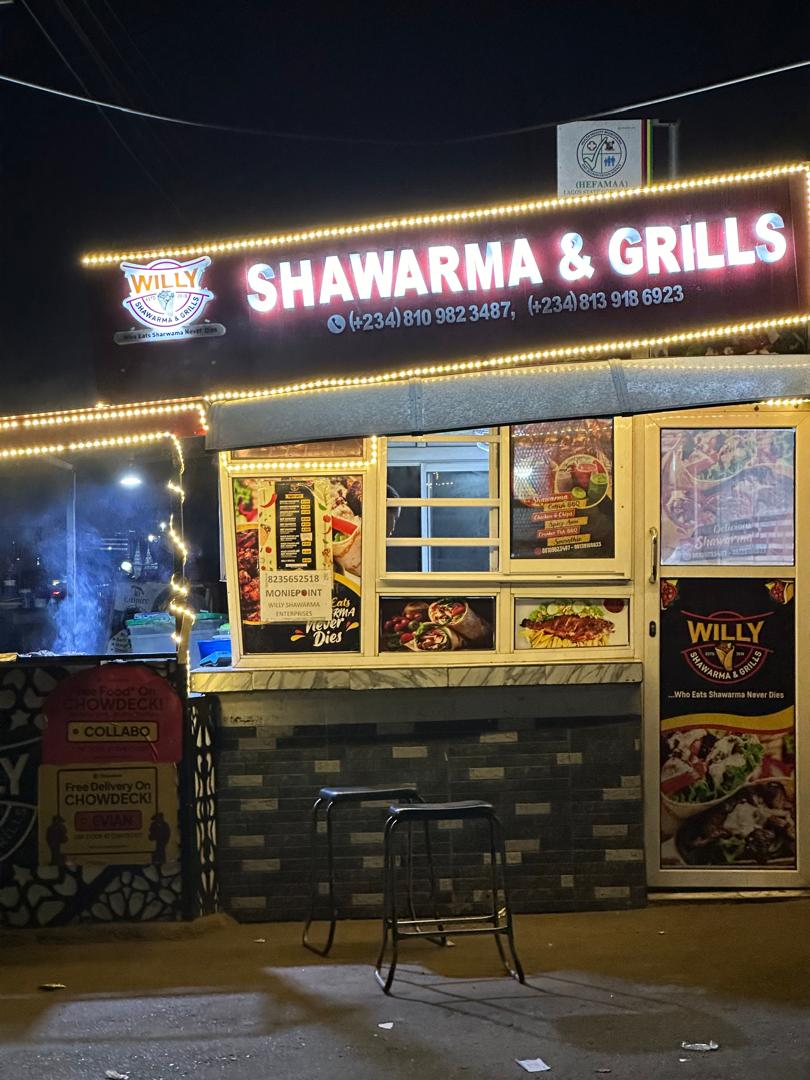
The operating environment
A real business, growing in real time.
The engagement took place inside an active multi-location food business. The work had to strengthen controls, people systems and management visibility while branches continued serving customers and the company continued expanding.
01 / The situation
The founder knew something was wrong.
Staff discipline was slipping. Expense leakage existed. The previous operations manager had been removed. But the deeper problem was harder to see: the business had outgrown the way it was being managed.
Willy’s had expanded to roughly seven or eight locations. As the footprint grew, informal relationships and founder-led decision making were carrying more operational weight than they could reliably hold. Employees could bypass managers and go directly to the owner. Branch purchasing created room for inflated expenses. Reporting was inconsistent. Some workforce health and operating certifications had lapsed.
The business did not simply need another document or a strategy presentation. It needed an operating layer.
Too many decisions and escalations still travelled back to the owner.
Decentralised purchasing and inconsistent reporting created avoidable leakage and poor visibility.
Personal relationships blurred accountability, while some roles were filled on familiarity rather than competence.
Existing hygiene practices needed strengthening and workforce medical checks and operating certifications needed renewal.
Evidence / Inventory control
The work left a paper trail.
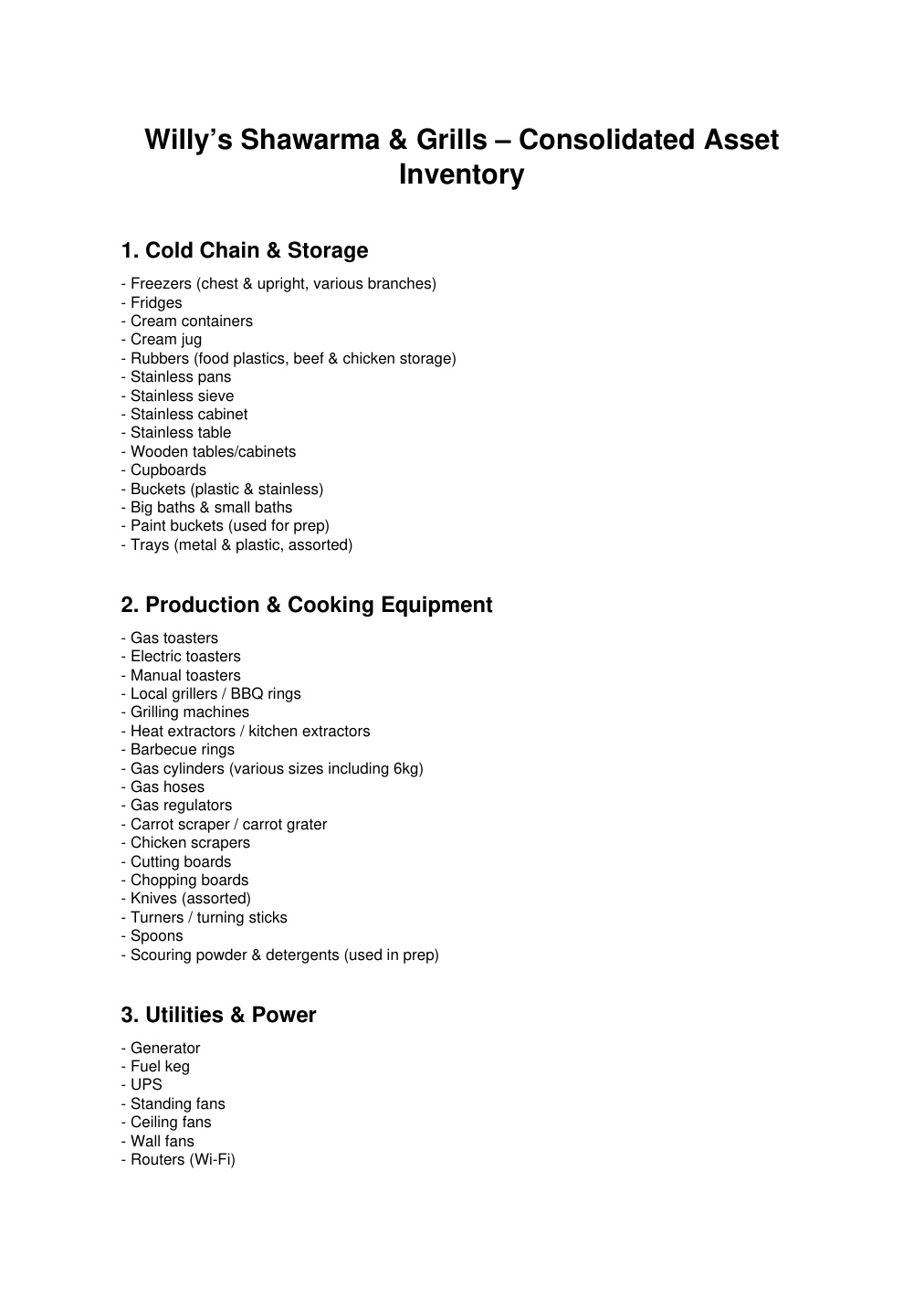
This is an actual inventory document used in the operating work — not a decorative reconstruction. It shows the level of detail required to move from informal branch knowledge to a consolidated view of assets and equipment.
Selected internal artifact · published without confidential personnel data
02 / My role
Advisory became operating responsibility.
I did not enter Willy’s intending to become its Head of Operations. The gap in the business made that necessary.
I stepped into the operating role while a permanent successor was being developed. Branch managers and zonal supervisors reported through the structure I was overseeing. I could direct managers, discipline staff, approve or reject expenses and make hiring decisions. Process changes and dismissals still required founder approval.
Daily work included management reporting, inventory review, expense approval, recruitment, staff meetings, branch issues, customer-experience training and coordination with the founder. Reporting was initially very frequent; as the operating rhythm became clearer, the cadence reduced.
03 / Controls
Make the business easier to see.
One of the biggest operational risks was not simply theft. It was that weak processes made leakage easier to hide.
A branch could purchase an item for ₦5,000 and report ₦10,000 for reimbursement. When every location sourced independently, verifying each expense consistently was difficult. We tightened expense approval and moved more purchasing toward centralised procurement, reducing the opportunity for that kind of leakage.
We also strengthened inventory controls and consolidated reporting across operations, production, supervisors and cashiers so discrepancies could be surfaced rather than buried inside separate records.
Evidence / Management visibility
A real management view, selectively redacted.
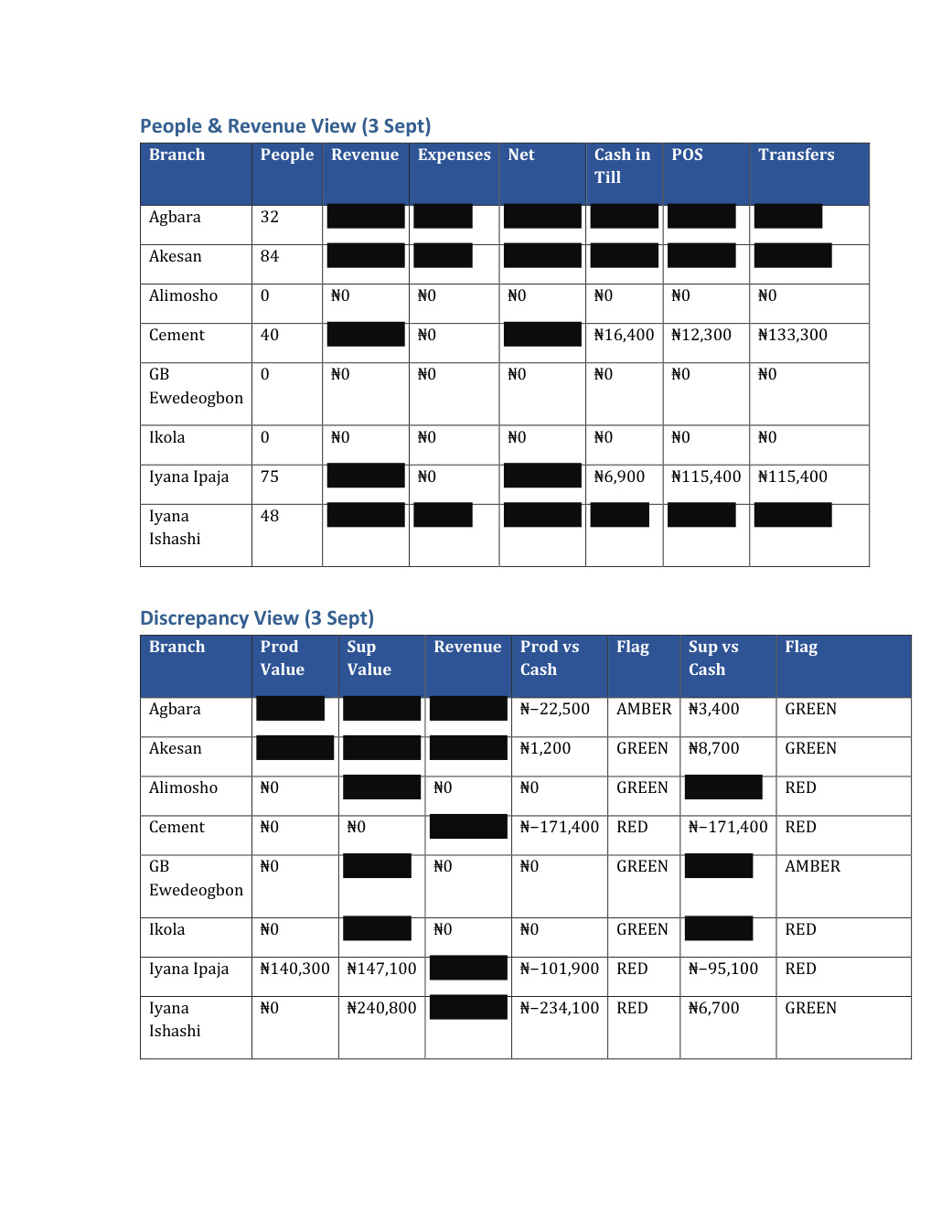
The operating rhythm pulled branch activity, revenue, expenses, payment channels and discrepancy checks into one view. Commercial values have been blacked out for the public portfolio; the structure of the reporting remains visible.
Actual client artifact · sensitive financial values redacted for publication
04 / People & standards
Systems only work when people know what is expected.
The work moved beyond reporting into the organisational conditions that made good operations possible.
We reviewed staff contracts, clarified reporting lines, strengthened recruitment, replaced a number of poor-fit staff with competency-based hires, and trained frontline teams on customer experience and corporate communication.
We also completed workforce medical screening and renewed relevant operating documentation, while strengthening hygiene procedures and requiring repairs and improvements in food-preparation areas where standards needed to be raised.
Not every change was welcomed. Staff pushback was one of the hardest parts of the engagement. People who had become comfortable with a relaxed operating environment experienced new reporting, controls and accountability as “too much.” The transformation challenge was therefore behavioural as much as procedural.
Evidence / People systems
Accountability also had to become operational.
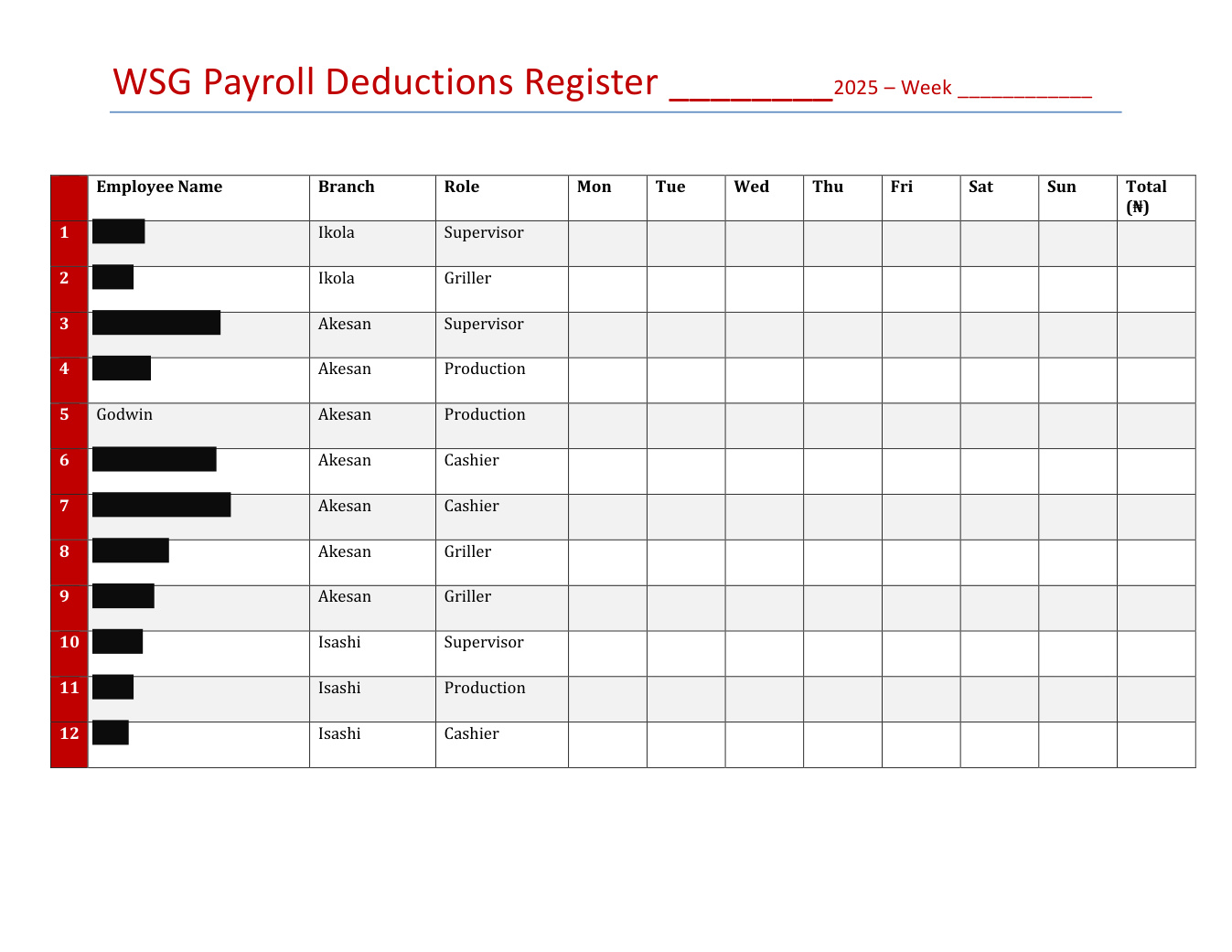
This register is one example of the people-management infrastructure around the engagement. Employee names have been blacked out; branch, role and reporting structure remain visible enough to show the underlying system.
Actual client artifact · personally identifying information redacted
05 / Growth
Stabilisation had to support expansion, not stop it.
The business continued opening locations while the operating model was being strengthened.
I supported recruitment and training for new staff, visited locations and helped create enough management structure for expansion to continue without every new branch simply adding another layer of founder dependency.
The work later extended into commercial strategy: looking at product economics, bundles and ways to increase average customer spend using the existing menu rather than relying only on more customer acquisition.
“The real problem wasn’t just structure or strategy. It was founder dependency.”
Willy’s reinforced something I now carry into operations work: founder dependency is not always created because everyone refuses to operate without the founder. Sometimes the founder has difficulty allowing the business to operate without them.
06 / What changed
More clarity. Better controls. Stronger operating discipline.
The engagement did not make the business perfect. It made it more operable.
People had a better understanding of where decisions and escalations belonged.
Inventory systems and management visibility were strengthened across the operation.
Poor-fit staff were replaced and new hires were increasingly selected for competence rather than proximity to the founder.
Reporting, controls and accountability created a more structured operating rhythm.
More issues could be handled within the management structure instead of automatically reaching the founder.
A person I had personally trained at Boltzmenn later joined Willy’s full-time as Operations Manager.
Portfolio note: this case intentionally avoids publishing individual employee health information, disciplinary records and other confidential personnel details. Financial and operational artifacts are shown selectively to demonstrate the nature of the work without exposing unnecessary client-sensitive information.
07 / What I learned
Growth asks the founder to change too.
Businesses grow in stages. The habits that help a founder build one stage can constrain the next.
A consultant can redesign structures, build reporting systems, recruit stronger people and introduce controls. But there is a limit to what any intervention can accomplish if leadership is not prepared to transfer authority along with responsibility.
Systems can create capacity. Leadership has to create the space for that capacity to work.